Author Archives: Bill Mitchell (AEØEE)

Transmitter Hunt Practice Saturday 9/21

Weather Update

Despite rain in the morning, the activity is go for a 1:00 PM start time.

Details

There was a lot of interest in the hidden transmitter hunt last week. At our monthly meeting, there were requests for a program on the final few meters of searching, covering both theory and practice. Accordingly, at 1:00 PM CDT on Saturday, September 21st we will have a hidden transmitter hunt (2-meter) practice session in Tarnhill Park (98th St. and Little Rd.) in Bloomington. The practice session will focus on on-foot techniques and relatively simple equipment. Bring what transmitter hunting equipment you have; there will be some extra gear available for use.

This is a fair-weather activity, and a final go/no-go decision will be made by 7 AM CDT on Saturday 9/21 and propagated on the BARA website post for this event.

Techniques

  • Built-in attenuator
  • Polarization
  • Third (and other) harmonic hunting
  • Slight frequency offsets
  • Body fade
  • Triangulation
  • Hunting with an omnidirectional antenna
  • Step attenuators (PDF)
  • Offset attenuators

Frequencies:

  • 146.565 MHz transmitter
  • 439.695 MHz 3rd harmonic
  • 293.130 MHz 2nd harmonic
  • 147.090 MHz (+600 kHz, no tone) voice repeater

Updates:

Go/No-go weather decision has been made, activity is go for 1:00 PM start time.

Hidden Transmitter Hunt Thursday 8/29

Overview:
With a stretch of nice weather in the forecast, it’s time to dust off the transmitter hunting gear! This Thursday (8/29/19), the Bloomington Amateur Radio Association will be hosting a transmitter hunt, beginning at 6:30 PM at Bloomington Civic Plaza from the parking lot on the west side of the building (near the southwest entrance).

The field of play will be the City of Bloomington, bounded on the west by US HWY 169, to the north by I-494, and to the south and east by the Minnesota River.

Format: Two hidden transmitters; one 500 mW to 1 W, the other 10-20 mW and in the general vicinity of the stronger transmitter. The transmitters will be on alternate 1-minute transmit windows.

Accessibility: A vehicle will be required for finding the transmitters, but at-home operators (in Bloomington and possibly surrounding municipalities) with omnidirectional or directional antennas can still contribute with coordinated hunting (see Resources below for tips from WB4APR). On-foot hunting is expected to take up to a mile of walking on sidewalks, dirt/grass paths, or over cut grass.

Difficulty: This is intended to be a beginner-friendly event, and those without directional antennas are encouraged to take part in a coordinated hunt (see Resources below). With sunset at 7:56 PM, the event will be complete around 8:00–8:15 PM.

Frequencies:
Two hidden transmitters: 146.565 MHz FM
Safety and administrative: 147.090 MHz, +600 kHz, no tone, analog FM (KD0CL VHF repeater)
Coordinated hunting: 443.175 MHz, +5 MHz, DCS 047 (TX and RX), analog FM (KD0CL UHF repeater; repeater is Yaesu C4FM capable, but please use analog for this event)

Resources:
Homing In, and specifically this page on first-time hunting techniques and equipment.
Bob Bruninga’s (WB4APR) Direction Finding Tips for those with Omnidirectional Antennas.
K6KN’s Presentation for SFARC on Transmitter Hunting.

Map:
Parks, roads, and lakes of Bloomington (PDF).

Contact:
Bill; AE0EE[at]arrl.net

Updates:
8/26/19 0105z: Added K6KN presentation link.
8/26/19 1846z: WB9CFN looking for teammate.
8/28/19 1652z: Added printable map of Bloomington.
8/29/19 1746z: Corrected UHF repeater frequency, 444.375 443.175 MHz.
8/29/19 2105z: Updated printable map to be more grayscale friendly.

Further updates will be added to this post on the BARA website.

February Meeting Cancelled, Replaced by Net

With the bad weather and road conditions, there will be no in-person meeting for the Bloomington Amateur Radio Association tonight. At 7:30 PM, we will instead host a net on the 147.090 (+600 kHz, no tone) repeater.

If there is interest after the net on our primary repeater, we may move to the 443.175 (+5 MHz, DCS 047) repeater, although its coverage is not as large.

The next in-person meeting will be Tuesday, March 5, 2019.

January VHF Contest 2019

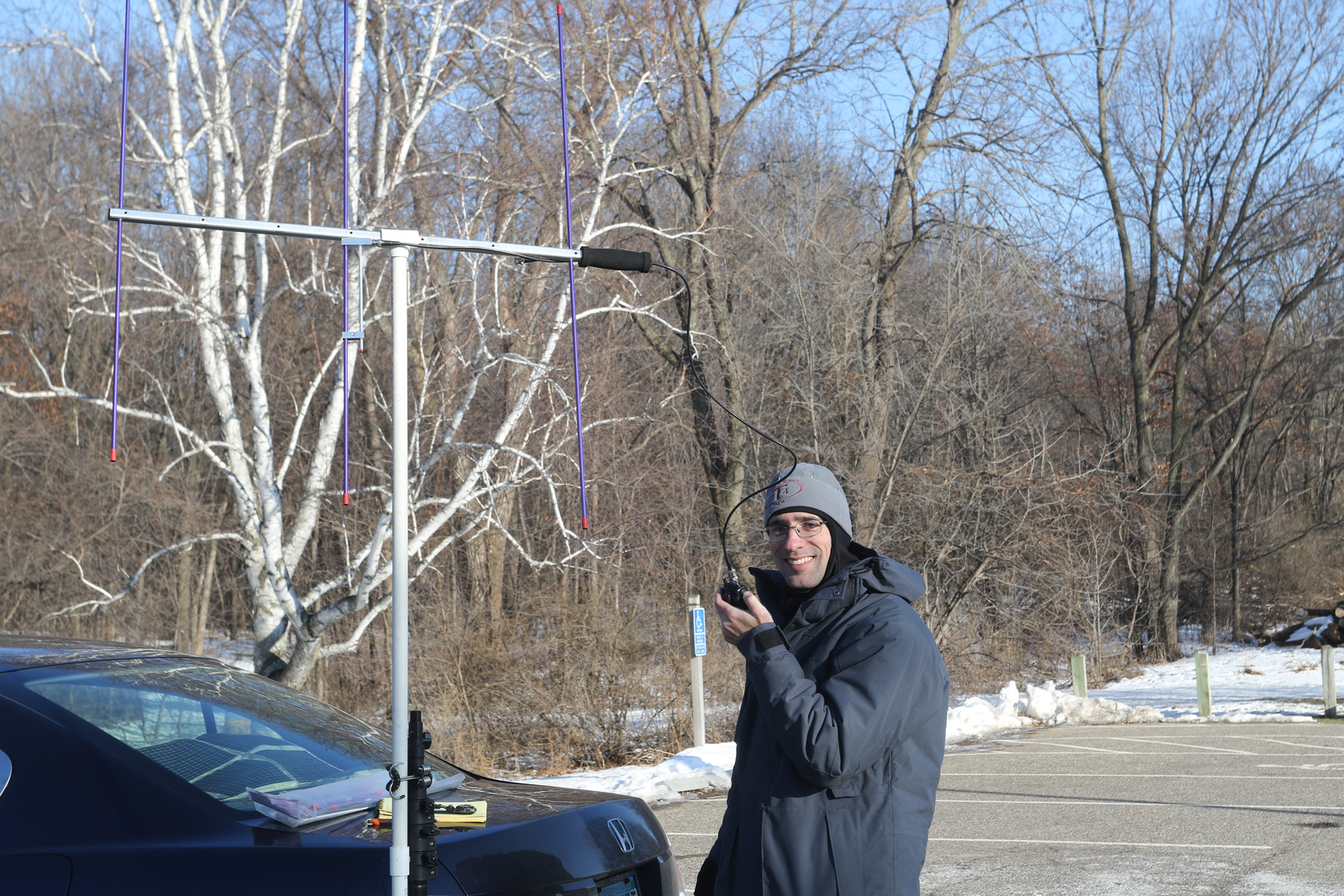
Bill, AE0EE, operates 2 m FM on a wintry day.

Bill, AE0EE, operates 2 m FM on a wintry day.

The ARRL January VHF Contest is coming up this weekend! There are three FM focus times (on 146.550 and 446.00 MHz simplex; times CST): 4:00-4:30 PM Saturday, 8:00-8:30 AM Sunday, and 9:30-9:59 PM Sunday (after the net). We have a 2-page quick-start guide and a 10-page introduction to VHF+ contesting if you want to read up on how to participate, and the Northern Lights Radio Society has a spreadsheet with the upper midwest VHF+ activity. The exchange is your grid square (EN34 for Bloomington and other south metro areas, EN35 in the north metro). Participating in the VHF contest is a great way to get a few contacts in the log and try out some simplex communications.

January 8 Meeting: Contesting 101

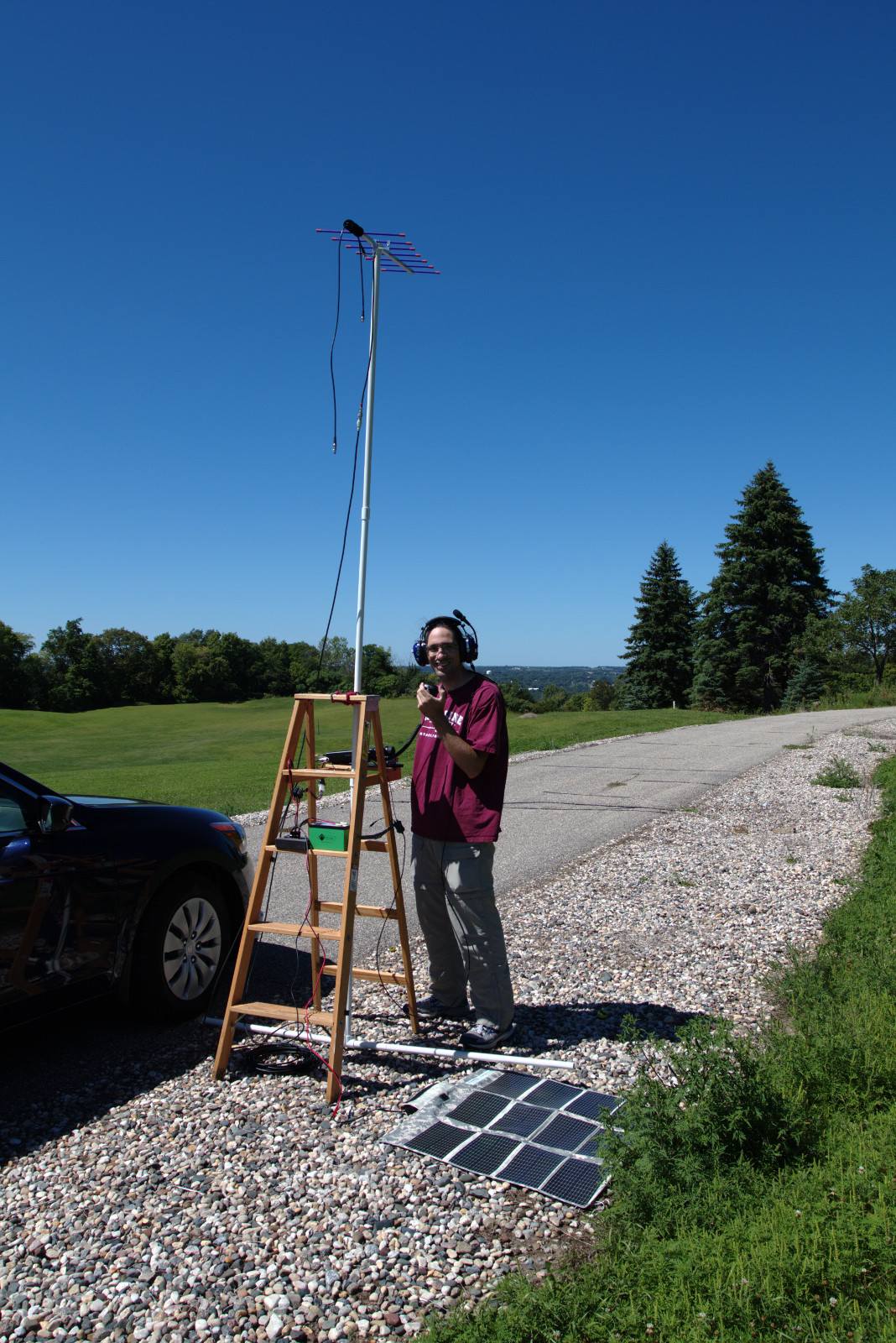
Bill, AE0EE, in a portable UHF operation.

Bill, AE0EE, in a portable UHF operation.

With New Year’s Day falling on a Tuesday, the January BARA meeting has been postponed to Tuesday, January 8, 2018, but will still meet in the Haeg Conference Room in Bloomington Civic Plaza at 7:30 PM. Use the entrance at the southwest corner of the building. If you need help finding or getting into the building, please call on the 147.090+ (no tone) repeater, or simplex on 147.090 MHz.

The program for the evening will be Contesting 101, and will cover the essential information needed to get started in contesting—be that VHF and above for contests like the ARRL January VHF contest, or HF for events such as the North American QSO Party or the Minnesota QSO Party. Contests are a great way to have fun, gain operating experience, test station capability, and establish good logging habits.

Can’t wait to learn more? Check out our Resources page!

September VHF Contest 9/8-9

This weekend is the American Radio Relay League’s September VHF
Contest, which runs from 1:00 PM CDT Saturday through 9:59 PM CDT
Sunday. There is going to be a lot of rover activity near the Twin
Cities, so be sure to hop on—especially if you can run SSB or FT8 on
6 m and 2 m. Even if you’re FM-only, listen on 146.550 FM simplex
and 446.000 FM simplex. Full rules here.

To make things more interesting for FM-only stations, I recommend
focusing on 4:00-4:30 PM Saturday, 8:00-8:30 AM Sunday, and 9:30-9:59
PM Sunday—or rather immediately following the Bloomington Amateur
Radio Association’s Sunday night net at 9:00 PM that takes place on
the 147.090+ repeater.

For the contest, you need to exchange and log callsigns and grid
squares, as well as recording frequency, mode, and time of the
contact. Bloomington and the south metro is in EN34 (echo november
three four), central and north metro should check here.
The pace of the
contest is usually slow enough that paper logging is a reasonable
choice—but you will probably want to enter it into a computer (e.g.
here) to submit for log
checking.

Sample exchange:
* 146.550 FM *
[K0BBC/R]: CQ contest, kilo zero bravo bravo charlie rover!
[W0ZQ]: Whiskey zero zulu quebec
[K0BBC/R]: Whiskey zero zulu quebec, echo november two five
[W0ZQ]: Echo november three four. Move to 446?
[K0BBC/R]: Sure! Kilo zero bravo bravo charlie rover
[W0ZQ]: Whiskey zero zulu quebec to 446.000
* Switch to 446.000 FM*
[K0BBC/R]: Whiskey zero zulu quebec, kilo zero bravo bravo charlie, rover!
[W0ZQ]: Kilo zero bravo bravo charlie rover, echo november three four
[K0BBC/R]: Echo november two five, thanks for another band, see you in
the next grid!
[W0ZQ]: Thanks! Whiskey zero zulu quebec
[K0BBC/R]: Kilo zero bravo bravo charlie rover, anyone else on frequency?
[K0BBC/R]: Kilo zero bravo bravo charlie rover back to 146.550

Coordination via non-amateur means (internet, cell phones, etc.) is
explicitly allowed for this contest as long as all necessary
information is exchanged over the air. That means you can phone or
text someone and choose a frequency and time (generally “now” or “in
five minutes when I get this thing set up”) to have a contact. This
is particularly useful with stations that have directional antennas or
if you want to make sure you get a contact with.

One place to look for activity is the Northern Lights Radio Society’s
activity spreadsheet.
The spreadsheet shows the bands and modes of both fixed stations
(first tab) and rovers (second tab), as well as the rover location
plans and contact info.

Another good place to go is the W0UC spots page.

If you have 6 m capability and can run WSJT-X, get on FT8! Make sure
you enable the VHF/UHF/Microwave features and check the “NA VHF
Contest” box. There should be some FT8 activity throughout the day.
Early in the morning (5-7 AM) you might also try WSJT-X’s MSK144 mode
to bounce signals off the ionized trails of meteors.

Want more action? Hop in your vehicle and join the Saturday
afternoon/evening rover pack near Winsted, MN! Even with just a
handheld, you will be able to work several other rovers at the corner
and run up a big score.

Using APRS or looking for rovers? Check out aprs.fi and the Mountain Lake APRS propagation page.

Some VHF contest resources can be found in Membership section of this website.
June VHF Club Challenge

On behalf of the Bloomington Amateur Radio Association, I would like to issue a challenge to local clubs around Minnesota (including their membership in surrounding states): can you get more stations on the air and logs submitted for the ARRL June VHF Contest than BARA?

With Field Day on the horizon, the June VHF contest is a good opportunity to get operators on the air and making contacts, even if it’s only on 2m/70cm FM. It would be fun to see if you can put your microphone where your mouth is and make a few contacts during the June VHF contest. The contest runs from 1:00 PM CDT Saturday 6/9 (1800z) to 9:59 PM CDT Sunday 6/10 (0259z Monday 6/11).

To make things a little less intimidating, I suggest three half-hour FM focus times during the contest, 4:00-4:30 PM Saturday 6/9, 8:00-8:30 AM Sunday 6/10, and 9:30-9:59 PM Sunday 6/10, using a frequency of 146.550 MHz (and 446.000 MHz). With these focus times, a casual operator doesn’t need to spend the whole weekend looking for contacts, and there’s even a category exclusively for FM-only operators.

The information exchanged is your four-character grid square, and you will need to log frequency, call, grid square, time (UTC) and mode. In Bloomington and the southern Twin Cities metro the grid square is EN34, but you should check yours before participating in the contest.

If you are interested in a quick overview of how to participate in a VHF+ contest, complete with recommended scripts for contacts, I urge you to take a look at this 2-page guide. For a more detailed discussion of VHF contesting, including modes other than FM, there is a longer guide here. Full rules for the ARRL June VHF contest can be found on the ARRL website.

Make sure that after the contest you submit your log to the ARRL! You can enter the data from paper logs and submit them directly using this web tool.

I hope to hear you on the air!
Bill
AE0EE
President, Bloomington Amateur Radio Association

The forecast on Sunday afternoon looks quite nice, so I’m planning to operate portable on 20 meters at Kenwood Park, somewhere on the hill near the center of the park from 2-5 PM CDT. If you’d like to come by and join me, you’re welcome to do so. It’ll be a bit like Field Day, except shorter (but very likely good weather). Bringing a pair of headphones/earbuds and a logging device (pad of paper, notebook, phone, computer) is recommended.

Left to my own devices I’ll be operating using Morse code, but I’ll have capability for all modes including voice, FT8, and RTTY for anyone who wants to join in and doesn’t know code by ear.

April Meeting Canceled

After consultation with the forecast products from the National Weather Service forecast office in Chanhassen, we have decided to cancel the in-person meeting tonight. Heavy snow throughout the day will make travel difficult this evening, and the BARA meeting is not sufficiently important to hold in-person.

However, we will take this opportunity to make use of the BARA repeater (147.090 MHz, +600 kHz offset, no tone), and will hold a net at 7:30 PM CDT. The BARA amendment vote will be held in May.

I hope to hear you on the air tonight!

April 3 Meeting: Bylaws Change

At the February meeting, a change in the Constitution and Bylaws was proposed to eliminate the requirement to hold a post office box. We did not reach a quorum at our March meeting. The change is now on the agenda for the April 3 meeting (7:30 PM, Haeg conference room, Bloomington Civic Plaza). The document showing the changes (eliminating the post office box requirement, updated dates, and a few minor corrections to names and locations) can be found here.